See Our CNC Machining Capabilities


Gallery of Our CNC Machining Parts


Why Choose Our Custom CNC
Machining Service

1-to-1 Quote Analysis
Just upload your 2D or 3D design and you will get quote feedback in 24 hours. Our specialized engineers will analyze your design to avoid misunderstanding in your 2D or 3D design, communicate with you and offer an affordable price.

Fast Lead Time
The introduce of advanced 5 axis CNC machining and professional quoters ensure the fast lead time. We set the priority for the arrangement of the order according to the requirements and order complexity.

High-Quality Production Parts
The responsible and rigorous attitude towards materials, machining technique, surface finishing and CMM testing guarantee the consistent quality from prototyping to production parts. We won’t bother to check the parts quality before delivery.

Instant Communication
For the sake of your benefits, every customer will have technical support to get in touch with us from quotation to delivery. You will get instant feedback for any question until it’s confirmed that you receive the satisfied parts.
Bring Your Design to Market

Rapid Prototyping
We have sufficient ability to deliver prototypes quickly after our research on the market and the improvement and upgrading of equipment and technique processes over the years. We have accumulated a wealth of successful experience in fast and high-quality delivery in aviation, new energy and other industries.

Bridge Production
Our elite engineers will confirm the details of the prototype via many ways such as online projection meeting according to your design drawings, and provide solutions on materials and technique processes for your core demands to ensure that the products meet your requirements.

On-Demand Production
We can produce the number of prototypes you need, whether it is small batch or large batch production after you receive the prototype and confirm that the appearance and function of the product meet your design requirements.
CNC Machining Tolerances and Standards
Standards
CNC Milling
CNC Turning
CNC Machining Materials

Aluminum
High machinability and ductility, good strength-to-weight ratio. Aluminum alloys have good strength-to-weight ratio, high thermal and electrical conductivity, low density and natural corrosion resistance.

Zinc
Zinc is a slightly brittle metal at room temperature and has a shiny-greyish appearance when oxidation is removed.

Iron
Iron is an indispensable metal in the industrial sector. Iron is alloyed with a small amount of carbon – steel, which is not easily demagnetized after magnetization and is an excellent hard magnetic material, as well as an important industrial material, and is also used as the main raw material for artificial magnetism.

Titanium
Titanium is an advanced material with excellent corrosion resistance, biocompatibility, and strength-to-weight characteristics. This unique range of properties makes it an ideal choice for many of the engineering challenges faced by the medical, energy, chemical processing, and aerospace industries.

Steel
Steel is a strong, versatile, and durable alloy of iron and carbon. Its applications range from construction materials and structural components to automotive and aerospace components.
Steel is strong and durable High tensile strength Corrosion resistance Heat and fire resistance Easily molded and formed.
Stainless steel
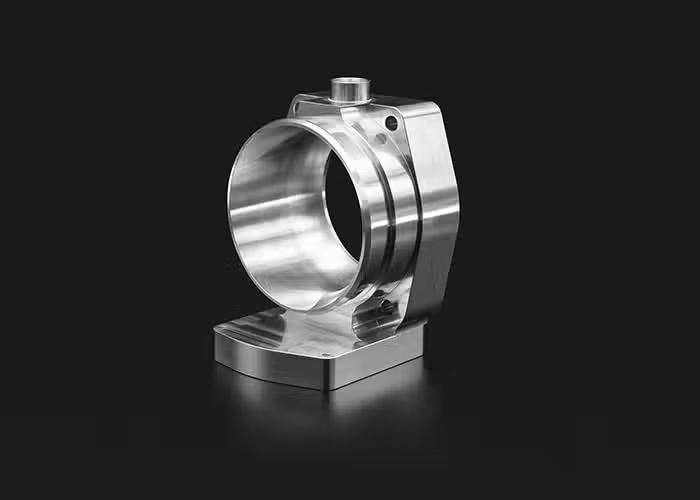
Stainless steel alloys have high strength, ductility, wear and corrosion resistance. They can be easily welded, machined and polished. The hardness and the cost of stainless steel is higher than that of aluminum alloy.

Bronze
Highly resistant to seawater corrosion. The material’s mechanical properties are inferior to many other machinable metals, making it best for low-stress components produced by CNC machining.

Brass
Brass is mechanically stronger and lower-friction metal properties make CNC machining brass ideal for mechanical applications that also require corrosion resistance such as those encountered in the marine industry.

Copper
Few metals have the electric conductivity that copper has when it comes to CNC milling materials. The material’s high corrosion resistance aids in preventing rust, and its thermal conductivity features facilitate CNC machining shaping.
CNC Machining Finishes

As machined, parts have minor visible tool marks and a surface roughness (Ra) of 1.6-3.2 µm.

Bead blasting is a cold treatment process used to remove old paint films with a thickness of not less than 2mm. It is widely used to improve the mechanical strength of parts, as well as wear resistance, fatigue resistance and corrosion resistance.

Sand blasting is to make the surface of parts for uniform matte treatment, according to the requirements of different sizes of sand can be sprayed, such as aluminum can spray #80-220 fine sand.

Painting can make the monotonous product look more beautiful after being sprayed with various colors, and at the same time, it can prolong the life and service life of the product because of an extra layer of protection.

Anodizing is an electrochemical process that converts the metal surface into a decorative, durable, corrosion-resistant, anodic oxide finish.

Plating is a process that is often used in CNC machining to add a protective or decorative layer to the surface of a component.

The surface of the material is coated with a layer of zinc to play the role of beauty and rust prevention.

Chroming process in CNC Surface Finishing is a metal finishing process that uses a chemical bath to deposit a thin layer of chromium onto the surface of a metal object.

A layer of nickel is plated on the surface of the material to improve the corrosion resistance of the material and have excellent polishing performance.

Laser engraving uses laser to engraving the logo or character logo you need onto your component.

The result of brushing is a unidirectional satin finish that is achieved by polishing the metal with grit.

Smooth polishing is to removes the machining marks from the surface of the workpiece, but there is no mirror effect.

Mirror polishing is a surface finishing process that can create a highly reflective, mirror-like finish on metal parts.

By silk screen printing, the ink is adhered to the products surface allowing it to be printed in a variety of colors at the same time, resulting rich and gorgeous effect.

E-coating is a CNC Surface Finishing process that uses electrochemical methods to deposit a protective coating onto metal parts.

Powder coating is a process used to coat metal parts with a protective and decorative layer of paint. It is often used for applications such as automotive, marine, and industrial part.

The passivation process can help to extend the life of the CNC surface, which can increase the longevity of the machine.

A technology that uses a metal workpiece as an anode and performs electrolysis in a suitable electrolyte to selectively remove its rough surface and improve the surface finish.

The heat treatment methods include vacuum heat treatment, bright heat treatment, nitriding, nitriding, QPQ and blackening. The hardness range of heat treatment is 40-60 HRC.

Alodine is a chemical surface finishing process used to produce a protective coating on aluminum and its alloys. It is also known as chemical film, or chromate conversion.

A more environmentally friendly and efficient alternative to preparing chromate conversion using safer raw materials. The chromate conversion process can be used for oxidation, corrosion protection and modification of metal surfaces to improve the durability and performance of parts

Black oxide provides corrosion protection, improved electrical conductivity, and improved wear resistance, making it a popular choice for CNC surface finishing.
Our Custom CNC Machining Services For Various Industrial Applications

Aerospace
More Details
Automotive
More Details
Semiconductor
More Details
Consumer Goods
More Details