Plastic material selection affects more than part appearance. It can change machining cost, tolerance stability, surface finish, assembly performance, wear life, and the risk of prototype failure.
ABS, polycarbonate, nylon, c, acrylic, PP, PE, PVC, and PEEK are all used for custom plastic parts, but they do not behave the same way. A material that works for a visual prototype may not work for a wear component. A transparent plastic may look correct on a drawing but crack around mounting holes if the design creates stress concentration. A high-performance plastic may add cost without improving the part if the service conditions do not justify it.
For engineers, designers, buyers, and hardware teams, the goal is not to find one “best plastic.” The goal is to match the material to the part function, operating environment, tolerance requirement, production stage, and manufacturing process.
This guide compares common types of plastics used for prototypes, CNC machined parts, and custom components, with a focus on practical manufacturing decisions.
Main Categories of Plastic Materials
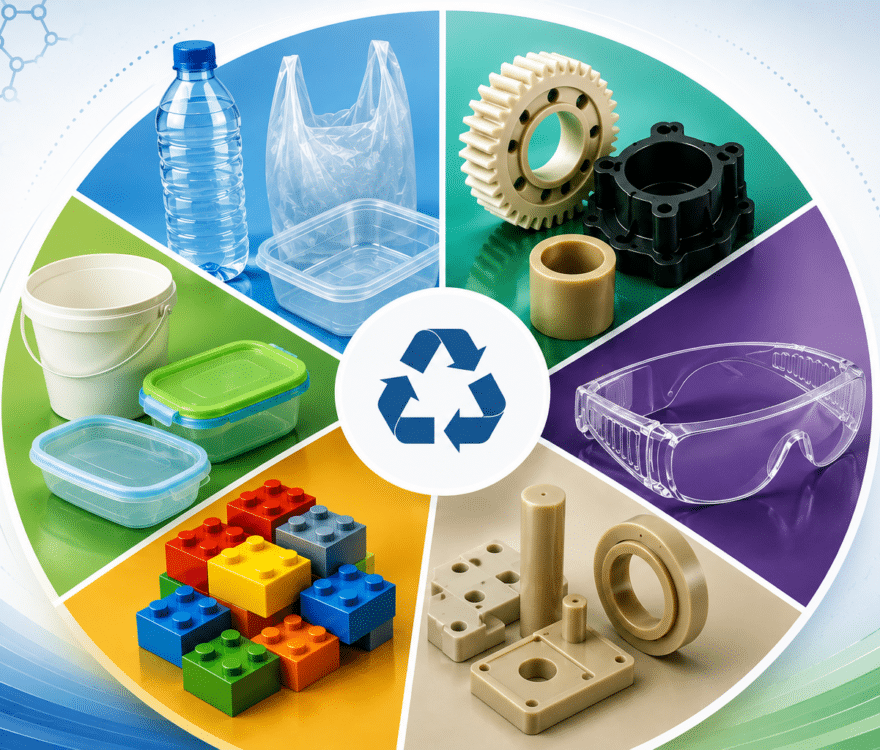
Plastic material types are often grouped into commodity plastics, engineering plastics, and high-performance plastics. These categories are useful for shortlisting materials, but final selection still depends on the grade, part geometry, and application.
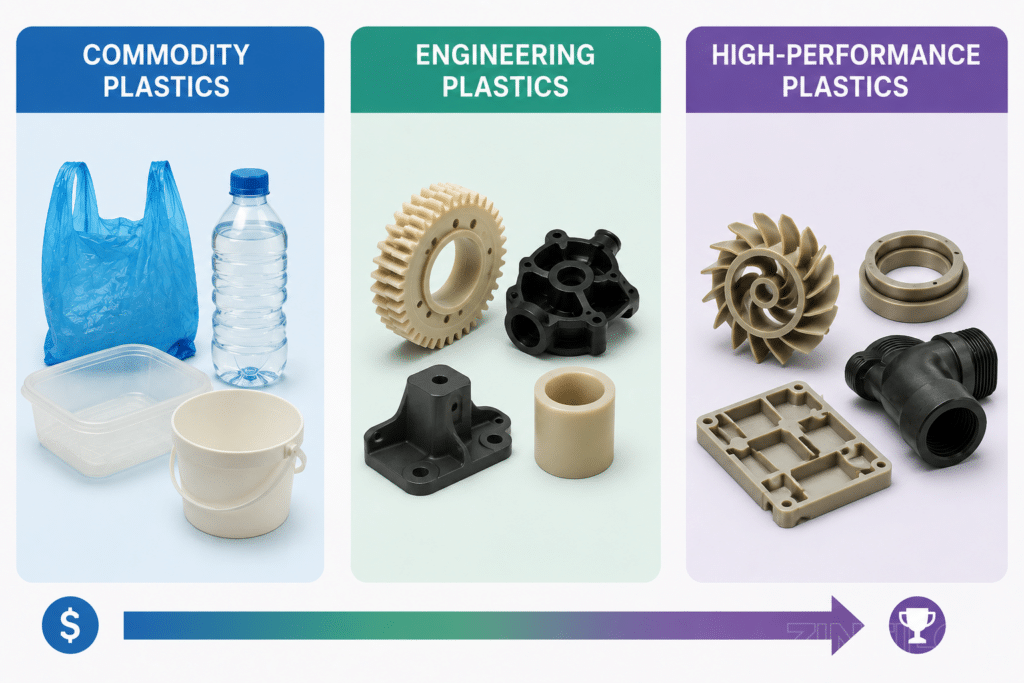
Commodity Plastics
Commodity plastics are often selected for cost, availability, light weight, and chemical resistance. Common examples include PP plastic, PE plastic, and PVC plastic.
These materials are used in covers, containers, panels, simple fixtures, fluid-related parts, and non-load-critical components. They can be practical when the part does not require high stiffness, tight dimensional control, or demanding mechanical performance.
The main risk is choosing a commodity plastic only because it is lower cost. If the part has threaded features, thin walls, tight tolerances, load-bearing areas, bonding requirements, or cosmetic surfaces, the material and geometry should be reviewed before production.
Engineering Plastics
Engineering plastics are used when a custom part needs better strength, toughness, wear resistance, dimensional stability, transparency, or surface appearance. Examples include ABS plastic, polycarbonate, nylon, POM plastic, and acrylic plastic.
These materials are common in functional prototypes, housings, brackets, jigs, fixtures, covers, gears, rollers, and precision machined components. For many CNC machined plastic parts, they offer a practical balance of performance, machinability, cost, and availability.
They are not interchangeable. A transparent cover, a sliding bushing, and a painted prototype housing may all be plastic parts, but their material requirements are different.
High-Performance Plastics
High-performance plastics are considered when standard materials cannot meet the application requirements. PEEK plastic is a common example.
PEEK may be considered when a part needs higher heat resistance, chemical resistance, wear resistance, or mechanical performance than lower-cost plastics can provide. It can be useful for demanding precision components, but its higher material cost must be justified by the actual service conditions.
High-performance material selection should be based on load, temperature, chemical exposure, wear conditions, grade requirements, and project risk. It should not be selected only because it sounds stronger or more advanced.
Common Types of Plastics for Custom Parts
ABS Plastic
ABS plastic is often used for general-purpose prototypes, housings, covers, enclosures, and product mockups. It offers a practical balance of impact resistance, machinability, cost, and appearance.
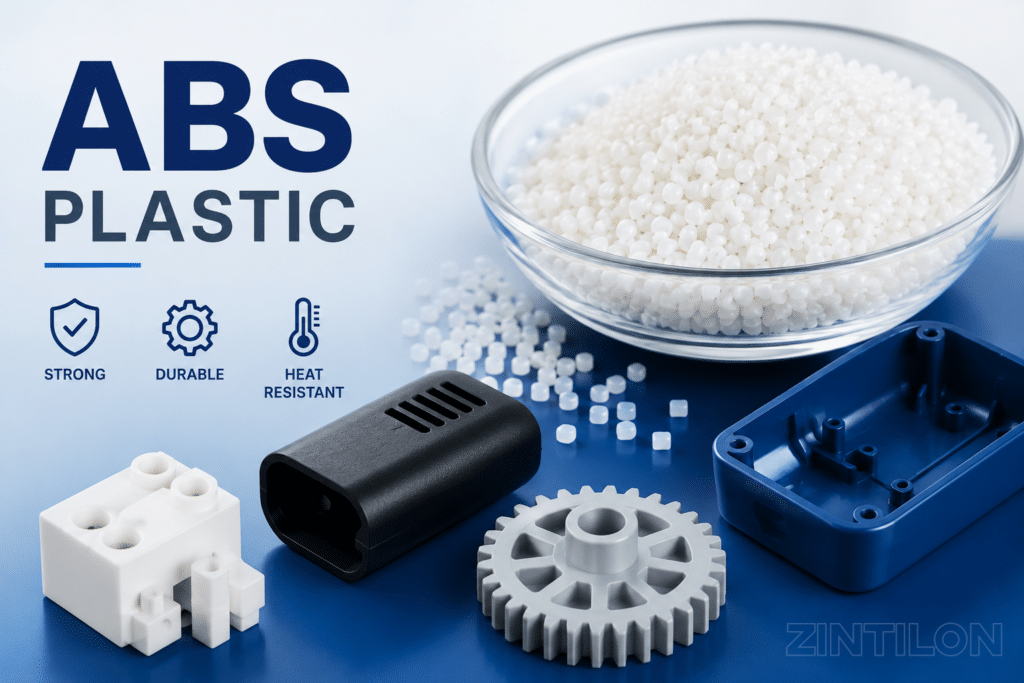
For CNC machined prototypes, ABS can be suitable when the project needs to evaluate shape, fit, assembly, and basic function. It can also work well for appearance models that may require painting or finishing.
The limitations should be checked early. ABS may not be suitable for high-temperature service, aggressive chemical exposure, or long-term outdoor use without grade review or surface protection. If the part will move from prototype to end use, the material should be reviewed against the real operating environment.
Polycarbonate
Polycarbonate is often selected for parts that need toughness and impact resistance, especially when transparency is also required. Typical uses include protective covers, guards, transparent panels, equipment windows, and impact-resistant housings.
Compared with acrylic, polycarbonate is often a stronger candidate for impact-prone transparent parts. However, it can scratch more easily, and chemical compatibility should be reviewed. Some cleaners, solvents, and operating environments may affect the material.
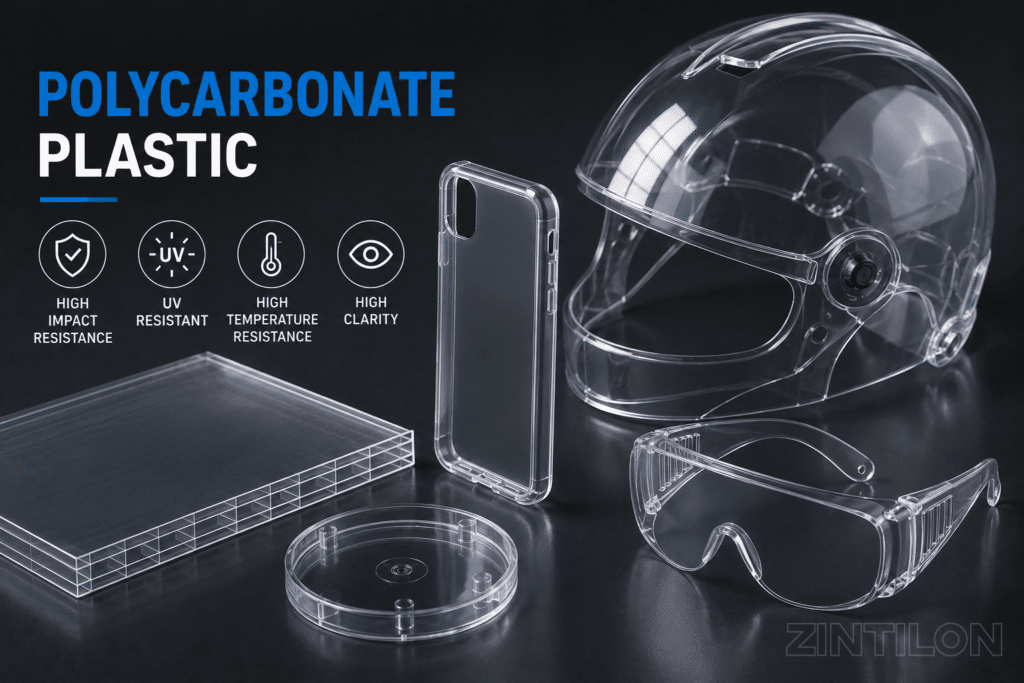
Design details matter. Sharp internal corners, high screw pressure, poor edge design, or uncontrolled machining stress can increase cracking or distortion risk. If a transparent PC part also requires tight tolerances or cosmetic surfaces, review the design before machining.
Nylon
Nylon is commonly used for parts that need toughness, wear resistance, and good behavior under repeated movement. It is often considered for gears, rollers, bushings, spacers, sliding components, and mechanical support parts.
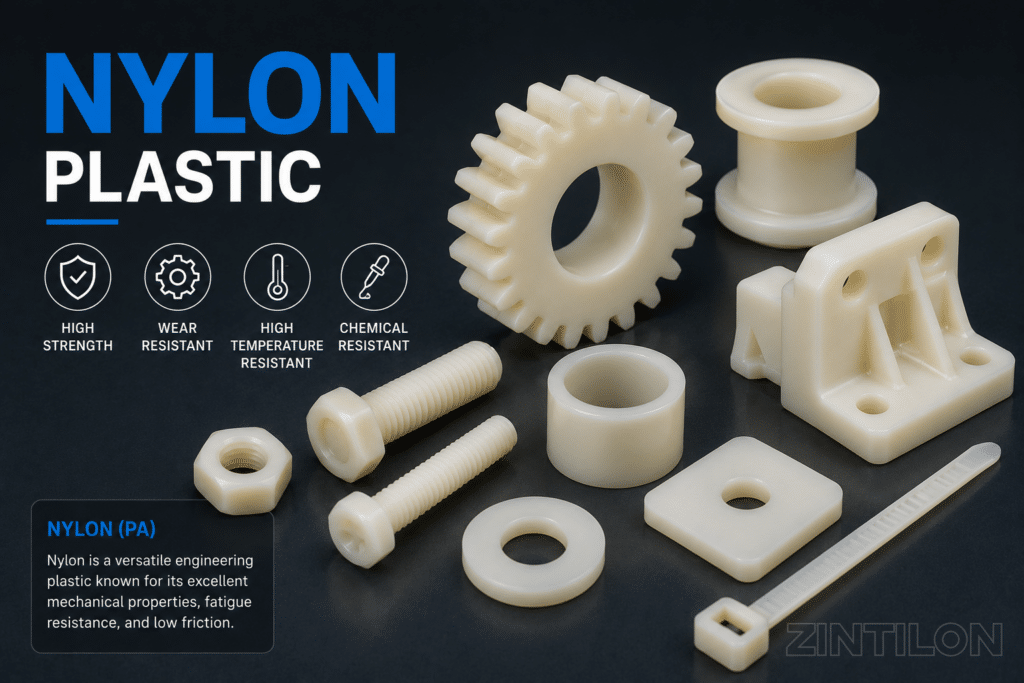
The key caution is moisture absorption. In humid environments, nylon can change dimensions and mechanical behavior. This does not make nylon unsuitable, but it means tolerance requirements, operating environment, and grade selection need to be reviewed.
For CNC machined nylon parts, thin walls, large flat surfaces, press fits, and tight-tolerance features require attention. Buyers should avoid specifying only “nylon” without grade or performance requirements, because different nylon grades can behave differently.
POM Plastic / Acetal
POM plastic, also known as acetal, is often selected for low-friction and dimensionally stable components. It is commonly used for gears, bushings, jigs, fixtures, sliding parts, and precision machined components.
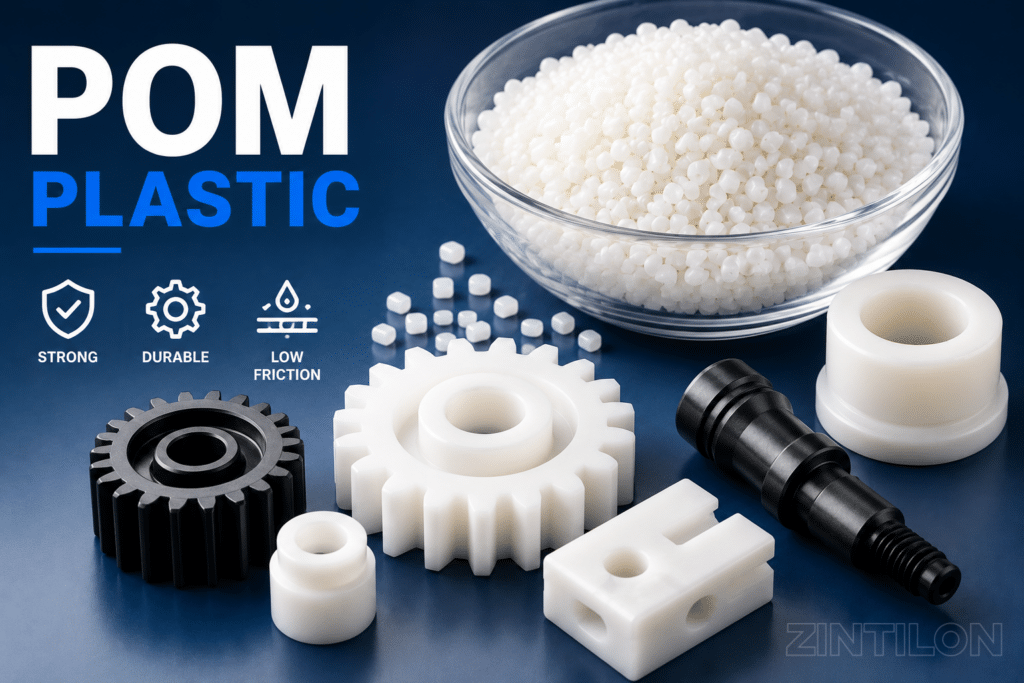
Compared with moisture-sensitive plastics such as nylon, POM is often considered when dimensional stability is important. It also machines well in many custom part applications and can be suitable for parts with mating surfaces or moving contact.
The main limitations are bonding, painting, and certain finishing operations. POM is not usually easy to glue or coat. If the part requires secondary bonding, decorative finishing, or surface treatment, confirm the manufacturing plan before finalizing the material.
Acrylic Plastic
Acrylic plastic, also known as PMMA, is commonly used when clarity and appearance are the main requirements. It is often selected for display parts, light guides, covers, panels, visual prototypes, and transparent components.
With suitable machining and polishing, acrylic can provide good optical appearance. It may be a strong candidate when clarity is more important than impact resistance.
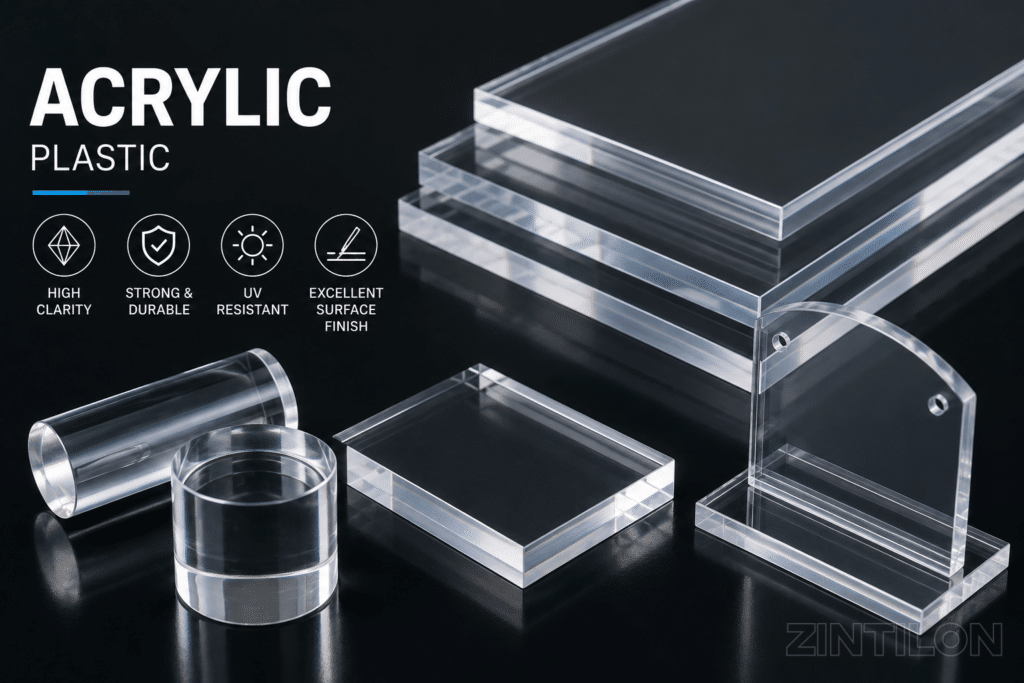
The trade-off is brittleness. Acrylic can crack, chip, or craze if the design, machining process, or assembly method is not suitable. It is not usually the first choice for impact-prone guards or heavily loaded transparent parts. For those applications, polycarbonate may be worth reviewing.
PP Plastic
PP plastic, or polypropylene, is lightweight and chemically resistant in many applications. It is often used for containers, covers, fluid-related components, simple housings, and parts where cost and chemical resistance are key concerns.
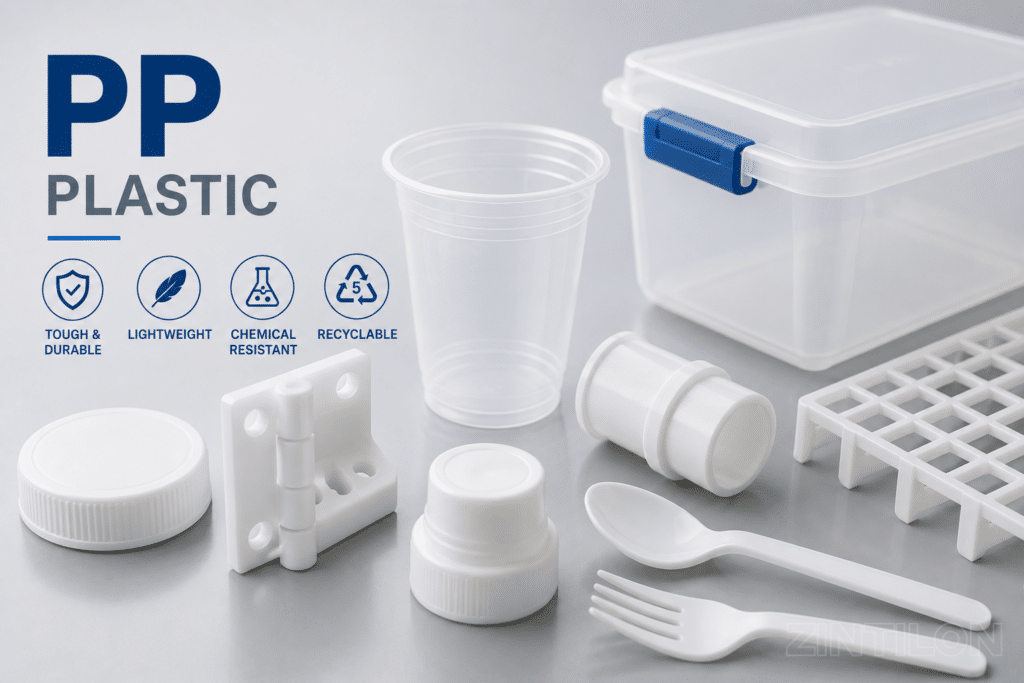
PP can be useful when the part does not require high stiffness or tight dimensional control. It may also be suitable when some flexibility is acceptable.
The main limitations are lower stiffness, limited bonding or painting performance, and more challenging precision machining compared with some engineering plastics. For custom PP parts, chemical exposure and mechanical requirements should both be checked before selection.
PE Plastic
PE plastic includes material types such as HDPE and UHMW-PE. HDPE is often used for chemical-resistant and lightweight parts. UHMW-PE is often considered for low-friction guides, liners, and wear components.
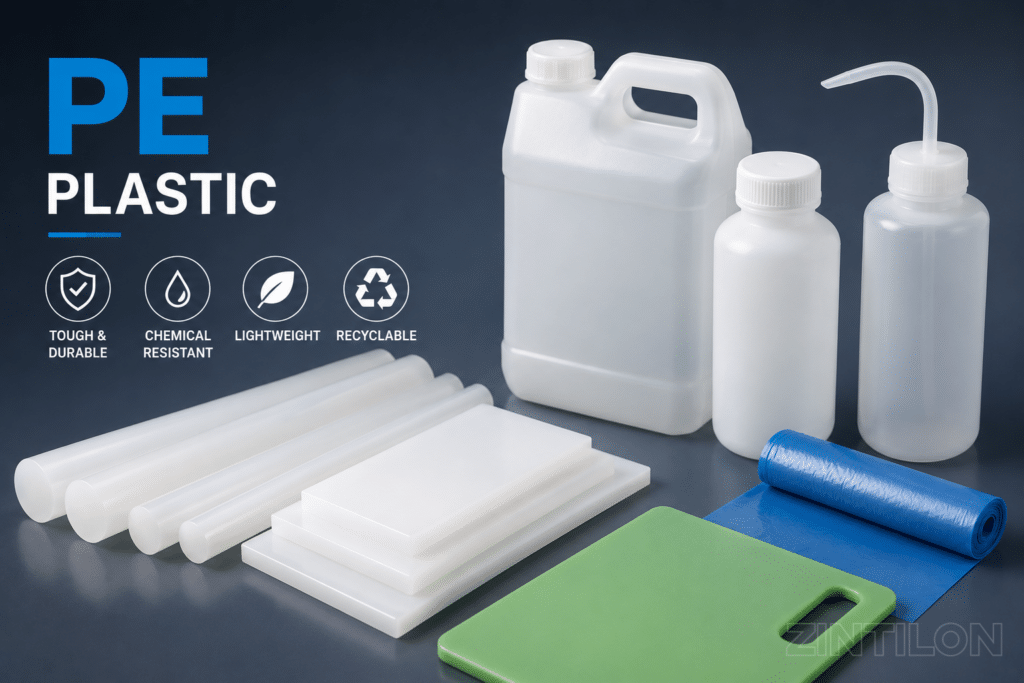
PE materials can be useful for industrial parts that need chemical resistance, impact resistance, or low-friction behavior. However, they usually have lower stiffness than engineering plastics such as POM or polycarbonate.
For CNC machined PE parts, precision features, thin sections, and tight tolerances require review. Adhesion, painting, and decorative finishing are also limited. If appearance, bonding, or high stiffness is required, another material may be more suitable.
PVC Plastic
PVC plastic is used in panels, fittings, covers, industrial components, and some chemical-resistant applications. It can also provide electrical insulation depending on the grade and application.
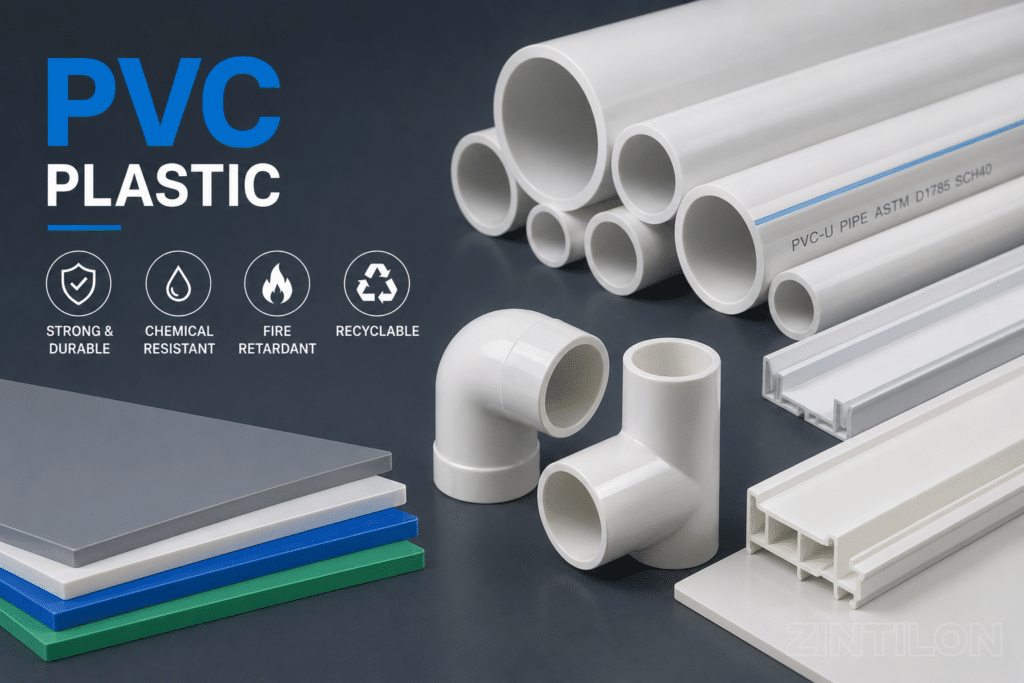
PVC may be selected when the part requires chemical resistance and moderate cost. However, operating temperature, application environment, and any regulatory requirements should be reviewed. During machining, heat control matters because excessive heat can affect edge quality and material behavior.
PVC should not be treated as a universal industrial plastic. For structural, high-temperature, or high-impact parts, other plastic material types may be more appropriate.
PEEK Plastic
PEEK plastic is a high-performance material used when parts need a combination of heat resistance, chemical resistance, wear resistance, and mechanical performance. It can be considered for demanding precision components when lower-cost plastics cannot meet the application requirements.
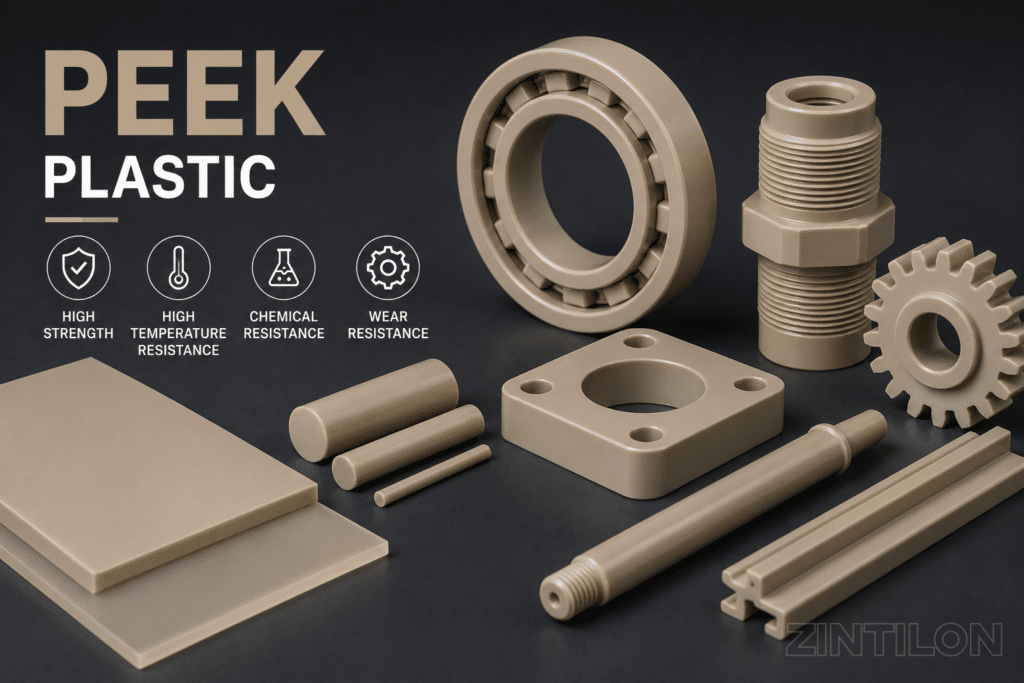
The main issue is cost. PEEK is significantly more expensive than many common engineering plastics. It should be specified when the operating environment justifies it, not simply because the part is critical.
Before choosing PEEK, engineers and buyers should confirm operating temperature, load, chemical exposure, wear conditions, grade requirements, and whether any documentation or compliance requirements apply.
Plastic Material Comparison for Custom Parts
Use this table as a starting point for shortlisting materials. It should not replace datasheet review, grade confirmation, or application testing.
| Plastic Material | Category | Typical Strengths | Common Custom Part Uses | Main Selection Caution |
| ABS plastic | Engineering plastic | Impact resistance, machinability, prototype appearance | Housings, covers, product prototypes | Limited heat and chemical resistance |
| Polycarbonate | Engineering plastic | Toughness, impact resistance, transparency | Guards, transparent covers, protective parts | Scratching, stress cracking, chemical compatibility |
| Nylon | Engineering plastic | Wear resistance, toughness | Gears, rollers, bushings, mechanical parts | Moisture absorption and dimensional change |
| POM plastic / Acetal | Engineering plastic | Low friction, dimensional stability, machinability | Precision parts, jigs, fixtures, sliding parts | Difficult bonding and painting |
| Acrylic plastic | Engineering plastic | Transparency, polished appearance | Clear covers, display parts, visual prototypes | Brittleness and cracking risk |
| PP plastic | Commodity plastic | Lightweight, chemical resistance | Containers, covers, fluid-related parts | Lower stiffness and finishing limitations |
| PE plastic | Commodity plastic | Chemical resistance, low friction, impact resistance | Liners, guides, simple components | Lower stiffness and adhesion limits |
| PVC plastic | Commodity plastic | Chemical resistance, insulation | Panels, fittings, industrial covers | Heat, application, and grade limits |
| PEEK plastic | High-performance plastic | Heat resistance, chemical resistance, wear resistance | Demanding precision components | High cost and grade-specific requirements |
How to Select the Right Plastic for Custom Parts
Start With the Part Function
Plastic material selection should begin with what the part must do.
A housing, transparent cover, sliding gear, chemical-resistant panel, and assembly fixture all have different material requirements. Before choosing a material, define whether the part is structural, cosmetic, transparent, protective, insulating, sliding, sealing, or used only for prototype validation.
Key questions include:
- Will the part carry load?
- Will it absorb impact?
- Will it contact chemicals, oil, water, or cleaning agents?
- Will it be assembled with screws, inserts, clips, adhesives, or mating parts?
- Does it need to be transparent, painted, polished, or marked?
- Is it a visual prototype, functional prototype, low-volume production part, or end-use component?
This step affects cost and quality. Choosing a material too early can lead to redesign, rework, failed testing, or unnecessary material cost.
Match Mechanical Requirements to Material Behavior
Plastic selection should distinguish between strength, stiffness, toughness, wear resistance, creep resistance, and impact resistance.
A part that must resist impact may point toward polycarbonate rather than acrylic. A sliding part may require nylon, POM, or UHMW-PE. A precision fixture may benefit from POM because of dimensional stability and machinability. A general prototype housing may work well in ABS if heat and chemical exposure are not major concerns.
Avoid choosing a material only because it is described as “strong.” A material can be tough but less stiff, stiff but brittle, or wear-resistant but difficult to bond. The correct choice depends on which property controls the part’s performance.
Check Heat, Moisture, and Chemical Exposure
The service environment can change the material decision.
Heat can reduce stiffness, affect dimensions, or create deformation risk. Moisture can affect certain plastics, especially nylon. Chemical exposure can cause swelling, cracking, softening, or surface damage depending on the material, chemical type, concentration, temperature, and exposure time.
For chemical exposure, PP plastic, PE plastic, PVC plastic, and PEEK plastic may all be considered in different cases. However, chemical resistance is grade-specific and application-specific. A material that works in one chemical environment may fail in another.
Review Dimensional Stability and Tolerance Before Machining
CNC machining is often used for custom plastic parts, functional prototypes, fixtures, and low-volume components. Plastics, however, do not behave exactly like metals during machining.
Plastic parts may move because of heat, internal stress, moisture, workholding pressure, or part geometry. Thin walls, deep pockets, large flat surfaces, and long unsupported features can increase dimensional risk.
For tight-tolerance plastic parts, review:
- Material stiffness
- Moisture absorption
- Part size
- Wall thickness
- Flatness requirements
- Threaded features
- Mating surfaces
- Inspection datum
- Expected service temperature
A tolerance that is straightforward in metal may be less practical in plastic, depending on the material and geometry. Before production, the drawing should identify functional dimensions, inspection points, and assembly-critical features.
For functional prototypes and low-volume custom plastic parts, Zintilon’s CNC machining services can help review drawing details, material requirements, and machining approach before production.
Consider Surface Finish, Transparency, and Appearance
Surface requirements can change the material choice and manufacturing cost.
Acrylic is often selected for clear appearance and polishability. Polycarbonate may be selected when transparent parts also need impact resistance. ABS can be suitable for painted prototypes or appearance models. POM, PP, and PE are more difficult to bond, paint, or print on because of their surface characteristics.
If the part needs polishing, painting, bonding, laser marking, threaded inserts, or cosmetic surfaces, confirm these requirements before material selection. A material that machines well may not finish well in the required way.
For transparent parts, appearance requirements should be specific. Define whether the part needs general transparency, polished edges, optical clarity, scratch control, or only a visual check. These requirements can affect machining strategy, finishing steps, cost, and inspection criteria.
Match Material Choice to Production Volume
Production volume affects both process and material selection.
For early prototypes, speed, availability, and design learning may matter more than final production behavior. For functional prototypes, the material should be closer to the intended use case. For low-volume production, CNC machining can avoid upfront tooling cost and support design changes. For higher-volume production, molding may become more economical, depending on geometry, material, and quantity.
Machined plastic prototypes are made from stock material, such as sheet, rod, or block. They can be useful for functional testing, but they should not always be treated as identical to molded production parts. Molded parts may involve shrinkage, flow direction, weld lines, gate location, and other process-specific factors.
During NPI, the material decision may evolve from a fast visual prototype to a functional prototype and then to a production-intent material. Zintilon’s rapid prototyping services can support early design validation, fit checks, functional testing, and material comparison before a design moves toward a later production process.
DFM Review for Plastic Parts
Design for manufacturability is especially important for plastic parts because the same material can behave differently depending on geometry and machining method.
Before releasing a plastic part for CNC machining, review:
- Thin walls that may deflect during machining
- Deep pockets that may increase vibration or heat
- Sharp internal corners that may create stress concentration
- Large flat surfaces that may warp or move after machining
- Small threads or inserts that may not hold well in softer plastics
- Screw bosses or mounting holes that may crack under assembly load
- Transparent edges that require polishing or cosmetic control
- Tight tolerances applied to non-functional areas
DFM review helps separate critical requirements from unnecessary cost drivers. Not every feature needs tight tolerance, polishing, or high-performance material. Clear drawings and realistic requirements can reduce quote ambiguity, machining risk, and inspection disputes.
Inspection and Quality Considerations
Plastic part inspection should be planned around function, not only nominal dimensions.
For functional parts, define critical dimensions, mating surfaces, hole positions, flatness requirements, and inspection datums. For flexible or low-stiffness plastics, the inspection setup can affect the measured result because the part may deform under clamping or handling.
For transparent or cosmetic parts, dimensions alone are not enough. Surface scratches, polishing marks, edge clarity, stock material defects, or stress marks may need visual acceptance criteria. These criteria should be agreed before production.
For parts exposed to heat, moisture, or chemicals, dimensional checks may need to consider the expected service environment. A part that measures correctly immediately after machining may behave differently after moisture exposure, temperature change, or assembly stress.
Practical Application Scenarios
Transparent Protective Cover
A transparent cover may use acrylic or polycarbonate, but the correct choice depends on what the cover must do.
If the priority is clarity, polished appearance, and visual presentation, acrylic plastic may be suitable. If the cover needs impact resistance or protective function, polycarbonate may be a better candidate.
Designers should check mounting holes, edge thickness, screw pressure, chemical cleaning, and scratch exposure. A clear plastic part can fail because the design creates stress concentration or the operating environment attacks the surface.
Wear-Resistant Moving Component
For a sliding or rotating part, nylon, POM, and UHMW-PE may all be considered.
Nylon can work well for tough wear components, but moisture absorption may affect dimensions. POM is often useful when low friction and dimensional stability are required. UHMW-PE may be suitable for guides, liners, and low-friction contact surfaces.
The material decision affects friction, wear life, noise, fit, inspection requirements, and replacement frequency. For procurement teams, a lower material price may not reduce total cost if the part wears faster or requires more frequent replacement.
CNC Machined Functional Prototype Housing
A functional plastic housing may use ABS, polycarbonate, or acrylic depending on the test purpose.
ABS may be suitable for general fit, assembly, and appearance review. Polycarbonate may be better if the prototype needs toughness. Acrylic may be useful when transparency matters, but it should not be treated as a high-impact material.
The project team should define what the prototype must prove. A visual prototype, assembly prototype, and performance test part may require different materials or manufacturing methods.
Chemically Exposed Component
For parts exposed to chemicals, PP, PE, PVC, and PEEK may all appear on the shortlist. The final choice depends on the specific chemical, concentration, temperature, exposure duration, mechanical load, and cost target.
Using PEEK where PP or PE is sufficient may increase cost unnecessarily. Using a lower-cost plastic without checking compatibility may create swelling, cracking, leakage, or early failure risk. For these parts, material review should happen before quoting and production, not after testing fails.
Common Plastic Selection Mistakes to Avoid
Choosing by Material Name Only
Material names can be too broad. Nylon, PE, PVC, ABS, and PEEK each include different grades. Additives, fillers, processing method, and supplier data can affect performance.
For final selection, check grade-specific datasheets and confirm whether the grade matches the part function and environment.
Treating Transparent Plastics as Interchangeable
Acrylic and polycarbonate are both transparent plastics, but they are not the same. Acrylic is often selected for clarity and polished appearance. Polycarbonate is often selected when impact resistance matters more.
Choosing the wrong transparent plastic can lead to cracking, scratching, poor appearance, or failed functional testing.
Ignoring Moisture and Dimensional Change
Moisture-sensitive plastics can change dimensions after machining or during use. This is especially relevant for nylon parts with tight tolerances, press fits, or mating features.
If the part will be used in a humid environment, dimensional stability should be part of the material selection process.
Over-Specifying Expensive Materials
High-performance plastics such as PEEK should be used when the application requires their performance profile. If the part does not face high heat, chemical exposure, wear, or demanding mechanical conditions, a lower-cost engineering plastic may be enough.
Over-specification increases material cost and may make procurement more difficult without improving part function.
Applying Metal-Part Tolerances to Plastic Parts
Plastics can deflect, expand, absorb moisture, and move during machining. A tolerance that is straightforward in metal may be more difficult in plastic, depending on geometry and material.
Before requesting tight tolerances, review the material, wall thickness, feature depth, flatness requirement, and inspection method.
Plastic Material Selection Checklist
Before requesting a quote for custom plastic parts, prepare the following information:
- CAD files and 2D drawings
- Part function and application environment
- Candidate material or required performance
- Quantity and production stage
- Load, impact, wear, and stiffness requirements
- Operating temperature
- Chemical, moisture, UV, or cleaning exposure
- Tolerance-critical features
- Surface finish or transparency requirements
- Assembly method, including screws, inserts, clips, or bonding
- Critical inspection dimensions or functional test requirements
- Any grade-specific or documentation requirements
This information helps the manufacturer evaluate material suitability, machining feasibility, cost drivers, and quality risks before production.
FAQ:
FAQs About Types of Plastics
What are the main types of plastics used for custom parts?
Common types of plastics used for custom parts include commodity plastics, engineering plastics, and high-performance plastics. Examples include PP plastic, PE plastic, PVC plastic, ABS plastic, polycarbonate, nylon, POM plastic, acrylic plastic, and PEEK plastic.
Which plastic is best for CNC machined parts?
There is no single best plastic for CNC machined parts. POM, ABS, polycarbonate, nylon, acrylic, and PEEK can all be machined, but the right choice depends on part function, tolerance, heat exposure, wear, chemical resistance, surface finish, and cost.
What plastic should I use for a transparent part?
Acrylic and polycarbonate are common choices for transparent parts. Acrylic is often selected for clarity and polished appearance. Polycarbonate is often selected when impact resistance is more important. The final choice should consider scratching, chemical exposure, mounting stress, and finishing requirements.
Is nylon suitable for precision mechanical parts?
Nylon can be suitable for mechanical parts such as gears, rollers, bushings, and wear components. However, moisture absorption can affect dimensions and performance, so nylon should be reviewed carefully for tight-tolerance or humid-environment applications.
When should I choose PEEK plastic?
PEEK plastic should be considered when the part requires heat resistance, chemical resistance, wear resistance, or mechanical performance that lower-cost plastics cannot provide. Because PEEK is expensive, the application should justify its use.
Selecting from different types of plastics is easier when the part function, tolerance requirements, surface needs, and service environment are clear. If you are developing a plastic prototype or CNC machined custom part, Zintilon can review your drawings, material requirements, quantity, and application notes to discuss material choice, machining feasibility, and a suitable manufacturing approach.
Great, Together