
Choosing the right casting method is crucial for manufacturing high-quality metal components. Die casting and sand casting are two of the most widely used techniques, each with unique benefits and limitations.
Both methods are essential for different industries, offering specific advantages based on project needs, material selection, and production goals. These processes can significantly impact a product’s overall success, from its design and functionality to its cost-effectiveness.
Your choice depends on factors like production volume, budget, material requirements, and the part’s specific application. This article will explore both methods in detail, comparing their features, pros, and cons to help you make an informed decision.
What is Die Casting?
Die casting is a manufacturing process where molten metal is injected into a mould cavity under high pressure. This method is highly efficient for producing complex and precise metal components in large quantities.
Features
- Precision and Accuracy: Die casting provides excellent dimensional accuracy, ensuring that parts meet tight tolerances.
- High Production Speed: Ideal for mass production, as the process is highly automated.
- Surface Finish: Produces parts with smooth surfaces, reducing the need for post-processing.
- Material Range: Typically used with non-ferrous metals such as aluminum, zinc, and magnesium.
Pros
- High Efficiency for Large Volumes: Once the mould is prepared, die casting allows for rapid production of large quantities.
- Excellent Surface Quality: The finished products require minimal machining or polishing.
- Durability and Strength: Produces robust parts capable of withstanding wear and tear.
- Complex Geometries: Enables the creation of intricate designs with high precision.
Cons
- High Initial Cost: Mould creation is expensive, making it less cost-effective for small batches.
- Material Limitations: Primarily used for non-ferrous metals, limiting its application for certain projects.
- Potential for Porosity: Gas can become trapped during casting, leading to weaknesses in the part.
- Limited Size Capability: Best suited for small to medium-sized components.
What is Sand Casting?
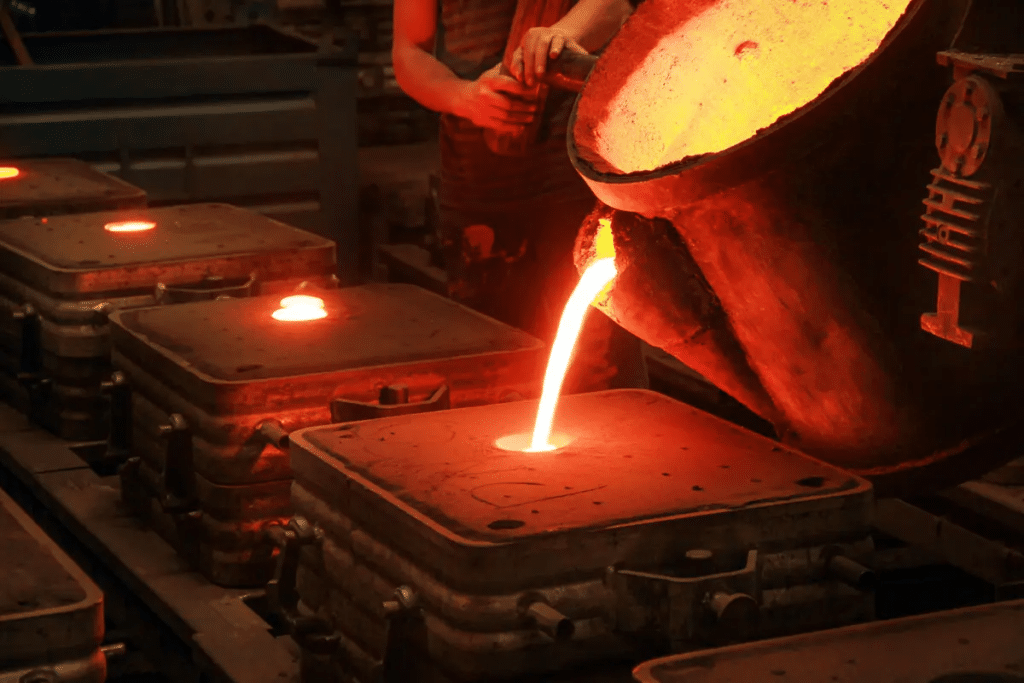
Sand casting is a traditional method where molten metal is poured into a sand mould. This process is known for its versatility and cost-effectiveness, especially for producing large and complex parts.
Features
- Adaptability: Can work with nearly any metal, including ferrous and non-ferrous materials.
- Size Flexibility: Suitable for creating large and heavy components.
- Low Initial Costs: Sand moulds are inexpensive and easy to produce.
- Simplicity: Requires less specialized equipment than die casting.
Pros
- Cost-Effective for Low Volumes: Ideal for short production runs or one-off custom parts.
- Material Versatility: Compatible with a wide range of metals, including iron and steel.
- No Size Constraints: Can produce parts of almost any size or weight.
- Simple Process: Easier to implement, requiring less investment in advanced machinery.
Cons
- Lower Precision: Produces parts with less dimensional accuracy, often requiring post-processing.
- Surface Finish: Rougher surface quality compared to die casting.
- Longer Production Time: Each mould must be individually created, which slows the process.
- Durability of Moulds: Sand moulds are single-use, which increases labour for large-volume projects.
Die Casting vs Sand Casting: Differences Comparison
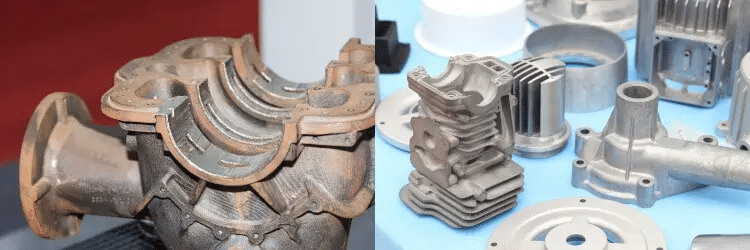
Both die casting and sand casting have their strengths, but they serve different purposes depending on project requirements. Below are key differences to consider:
Cost and Budget
Die Casting: Die casting involves a significant initial investment due to the cost of creating durable metal dies. However, this investment pays off for large-scale production runs as the cost per unit decreases significantly with volume. The efficiency and automation of the process result in faster cycle times, further reducing costs for mass production.
Sand Casting: Sand casting has a much lower setup cost, as the moulds are made from inexpensive sand materials and are typically single-use. This makes sand casting ideal for low-volume production, custom parts, or prototypes where high upfront investment is not justifiable. However, for mass production, sand casting becomes less economical due to the repeated cost of mould creation and the slower production process.
Precision and Surface Quality
Die Casting: Die casting offers superior precision and surface finish. The hardened steel dies allow for tight tolerances and produce parts with a smooth, refined surface that often requires little to no post-processing. This makes die casting ideal for applications where aesthetic quality and precision are critical, such as consumer electronics and automotive components.
Sand Casting: In contrast, sand casting typically results in parts with a rougher surface texture. The sand moulds naturally impart a granular finish, and dimensional tolerances are less exact than those achievable with die casting. Additional machining or finishing processes are often required for parts that need a smoother surface or higher dimensional accuracy.
Material Compatibility
Die Casting: Die casting is primarily limited to non-ferrous metals such as aluminum, zinc, and magnesium. These materials are lightweight, corrosion-resistant, and suitable for applications requiring a combination of strength and reduced weight, like automotive or aerospace components.
Sand Casting: Sand casting, however, offers unmatched versatility in material selection. It can handle both ferrous and non-ferrous metals, including steel, iron, brass, and bronze. This flexibility makes it a preferred method for industries that require durable and heat-resistant components, such as heavy machinery and construction.
Part Size and Complexity
Die Casting: Die casting is ideal for manufacturing small to medium-sized parts with intricate geometries. The process excels in producing complex shapes with fine details, thin walls, and internal cavities, making it suitable for precision components in various industries.
Sand Casting: For larger and simpler components, sand casting is the preferred method. The sand moulds can accommodate oversized parts that are difficult or impractical to produce using die casting. This capability is essential for applications like engine blocks, large pump housings, or structural components.
Production Speed
Die Casting: Die casting is a highly automated process, capable of producing large volumes of parts in a short period. Once the die is created, the production cycle is rapid, with minimal human intervention required. This makes die casting highly efficient for industries needing quick turnaround times.
Sand Casting: In contrast, sand casting is more labour-intensive and slower. Each mould must be individually prepared, filled, and broken down after use, which extends the production timeline. This process is better suited for projects where speed is less critical, and customisation is a priority.
By carefully weighing these differences, businesses can determine which casting method aligns best with their project goals.
Contrast Table
| Feature | Die Casting | Sand Casting |
| Cost | High initial cost, cost-effective for large volumes | Low initial cost, better for small batches |
| Precision | High dimensional accuracy | Lower dimensional accuracy |
| Surface Finish | Smooth, requires minimal post-processing | Rough, often requires machining |
| Material Suitability | Non-ferrous metals | Wide range, including ferrous metals |
| Part Size | Small to medium | Suitable for large and heavy parts |
| Production Speed | Fast for high volumes | Slower, labour-intensive |
| Tooling Durability | Long-lasting moulds | Single-use sand moulds |
Die Casting vs Sand Casting: How to Choose?
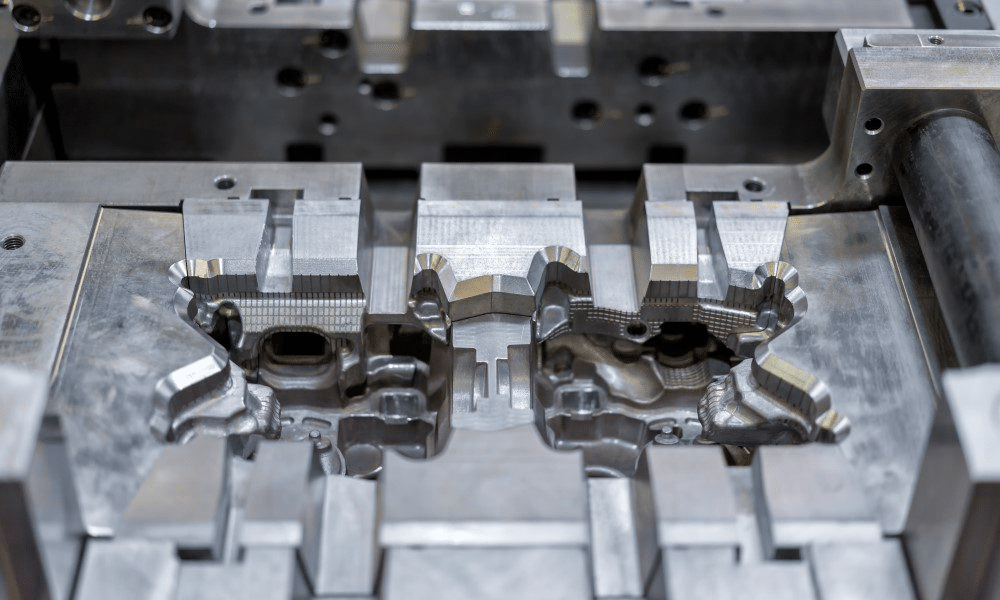
Choosing between die casting and sand casting depends on a variety of project-specific factors. Below, we expand on the critical considerations to help you make an informed decision.
Production Volume
High Volume Production: If your project involves the mass production of parts, die casting is an excellent choice. The process uses reusable metal moulds, also known as dies, which can produce thousands of components with consistent quality. Once the initial investment in the die is made, the cost per unit decreases significantly, making die casting cost-effective for high-volume production runs.
Low Volume Production: Sand casting, by contrast, is better suited for low-volume production. Since the moulds are made of sand and are generally single-use, there is no significant upfront cost for permanent moulds. This makes sand casting a practical and economical solution for smaller production runs, prototypes, or custom parts.
Part Complexity and Size
Complex Designs: Die casting is highly precise and can produce parts with intricate details and tight tolerances. The method is particularly beneficial for manufacturing small to medium-sized parts with complex geometries, such as those used in the automotive or electronics industries. Features like thin walls, fine edges, and detailed surface textures can be easily achieved with die casting.
Large Components: Sand casting, on the other hand, excels in creating large or heavy components. The sand moulds can be customized to accommodate oversized parts that would be difficult or impossible to produce using die casting. Industries like construction, marine, and heavy machinery often rely on sand casting for components such as engine blocks, pipes, and pump casings.
Budget Constraints
Higher Budget Projects: Die casting requires a significant initial investment due to the cost of creating durable metal dies. However, this investment is offset over time for high-volume projects, as the reusable dies lower the cost per unit. If your project has a larger budget and aims for long-term production efficiency, die casting is the way to go.
Lower Budget Projects: For projects with tighter budgets, sand casting offers a more accessible entry point. The use of inexpensive and easily replaceable sand moulds significantly reduces the upfront costs. This makes it an ideal choice for businesses that need functional parts without the financial commitment to high-volume production tooling.
Material Selection
Non-Ferrous Metals: Die casting is particularly well-suited for non-ferrous metals like aluminum, zinc, and magnesium. These materials are lightweight, corrosion-resistant, and capable of producing strong yet thin-walled parts. Aluminum die casting, for example, is widely used in the automotive industry for lightweight components that improve fuel efficiency.
Wide Range of Metals: Sand casting offers greater flexibility when it comes to material selection. It can handle a broad range of metals, including ferrous materials such as iron and steel, which are not typically used in die casting. This versatility allows manufacturers to select the most suitable metal for their specific application, whether it’s for strength, heat resistance, or wear properties.
Tooling and Lead Time
Die Casting Tooling: The creation of metal dies for die casting is a time-consuming process that requires precise machining and finishing. This results in longer lead times for the initial production run. However, once the dies are ready, production can proceed rapidly, with minimal downtime between cycles.
Sand Casting Tooling: Sand casting offers quicker tooling since moulds can be created directly from patterns, often in a matter of hours. This makes it a faster option for projects that require rapid prototyping or urgent production timelines. However, because sand moulds are single-use, each production cycle requires the creation of a new mould.
Surface Finish and Post-Processing Requirements
Die Casting Surface Finish: One of the key advantages of die casting is its ability to produce parts with smooth surfaces and fine details straight out of the mould. This reduces the need for extensive post-processing, saving time and costs in secondary operations like machining or polishing.
Sand Casting Surface Finish: In contrast, parts produced via sand casting typically have a rougher surface due to the texture of the sand moulds. While this is acceptable for many industrial applications, components requiring a smoother finish may need additional post-processing, such as grinding, polishing, or coating.
Durability and Lifespan of Moulds
Die Casting Mould Durability: Die casting moulds are made from hardened steel, giving them exceptional durability and a long lifespan. They can produce thousands or even millions of parts before needing replacement, making them an excellent choice for high-volume, long-term projects.
Sand Casting Mould Durability: Sand moulds, by nature, are not reusable. Each casting cycle requires a new mould, which increases material consumption but offers unparalleled flexibility in mould design. This trade-off is often acceptable for projects that demand customisation or low-volume production.
Conclusion
Both die casting and sand casting are essential in manufacturing, each with unique advantages. Die casting offers high precision, speed, and smooth surface finishes, making it ideal for mass production of small to medium parts. Sand casting, however, provides flexibility and cost-effectiveness for large, custom, or low-volume projects.
Choosing the right method depends on factors like budget, volume, and material requirements. For expert guidance, Zintilon delivers exceptional casting solutions tailored to your needs, ensuring high-quality results and efficient production. Trust Zintilon to help you select the best process for your project.
Great, Together


